Resources in Graveyard Keeper 2
Every plank, stone, and organ you harvest — where to find it, how to carry it, and why supply chains matter.
Graveyard Keeper 2 has an economy built on harvesting. The Steam store copy is explicit: harvest flora, fauna, and human remains to build machinery and expand the yard for profit. This page maps every resource category, where to find it, and how it connects to the production systems covered in automation and the tech tree.
If you need the conversion chain (raw material → processed good → sold product), start at automation. If you need the harvest location itself, read here.
Resource categories
The game groups resources into five harvesting categories:
- Flora — plants, herbs, wood, leaves
- Fauna — animal products, meat, hides
- Minerals — stone, clay, iron ore, coal
- Remains — corpses, organs, bones (see graveyard)
- Manufactured — processed goods from workstations
Each category has specific harvest locations and tools. Forcing a flora tool on a mineral node wastes time.
Flora and forest resources
Wood is the most common early resource. The Garden location shows the Keeper carrying logs on their shoulder — wood is not auto-collected, you physically move it. Early wood harvest:
- Look for the Chopping tech tree node
- Trees near the Graveyard and Garden locations
- Respawn timers apply; do not strip one zone
Leaves appear in resource guides as a specific harvested item. They are tied to alchemy (see alchemy) and possibly composting for farming.
Herbs are alchemical reagents found in The Swamp where Clotho the alchemist lives. Daytime harvesting recommended; some herbs may be location-gated or season-gated.
Mineral resources
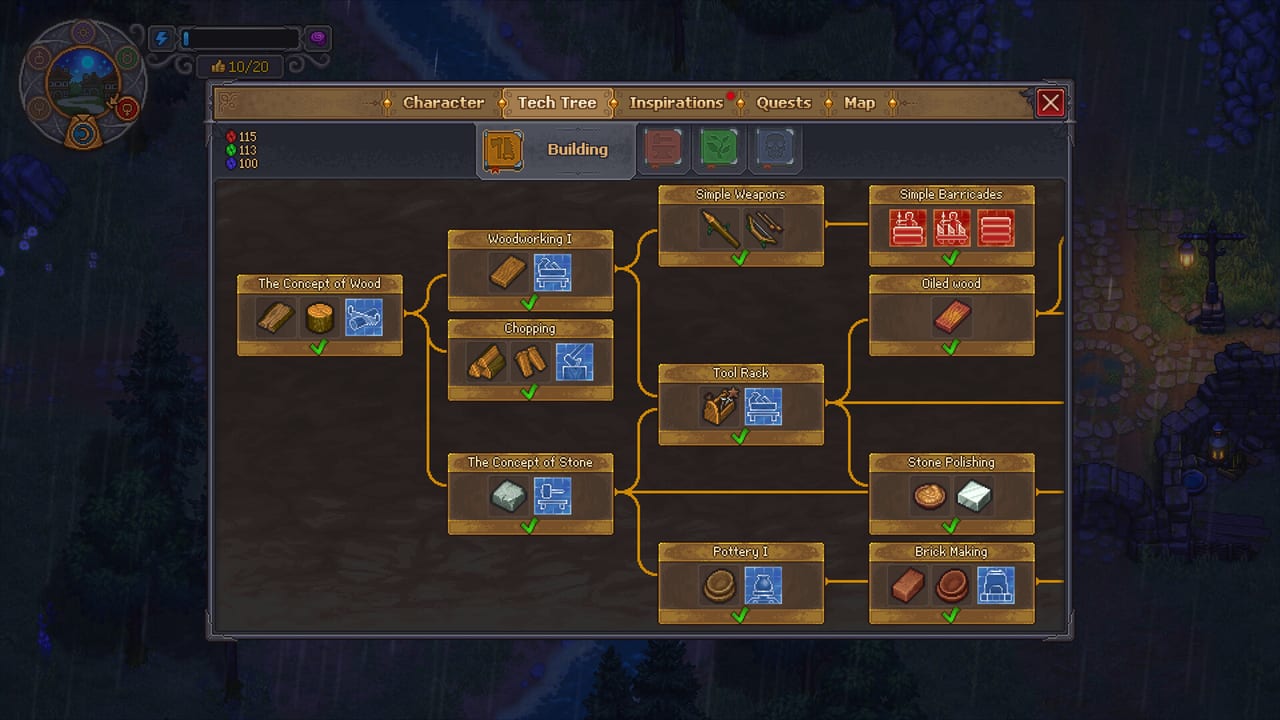
Stone is the second primary building material. The Building tech tree branch includes:
- The Concept of Stone
- Stone Polishing
- Brick Making
Stone nodes appear near the Graveyard and in rocky outcrops. Early game, you need stone for:
- Graveyard monuments and modules
- Barricades for combat
- Town Workshop walls
Clay is tied to pottery nodes on the tech tree (Pottery I). Clay deposits are often near water or swamp areas. The Swamp is your best early clay source.
Iron ore is mid-game. You need it for:
- Simple Weapons on the Building tree
- Tool Rack unlocks
- Any metalworking beyond basic tools
Coal is the smelting fuel. Without coal, your furnace outputs nothing. Locate coal deposits before committing to a metal production line.
Fauna and animal resources
Meat comes from hunting or farming. The farming page covers the Garden; hunting is a separate activity in the wild zones outside Town walls.
Hides and leather are animal products used in:
- Armor crafting (promised in store copy, specific node TBD)
- Tool Rack improvements
- Barricade reinforcement
The donkey cameo is a mount, not a resource animal. Do not expect donkey-based hide production.
Remains and corpse economy
The graveyard management page covers skull ratings and corpse sorting. Remains are not just gravestones:
- Organs — export to Town or use in alchemy
- Bones — crafting material for tools and weapons
- Corrupted remains — better for zombie army training
The May 2026 zombie diary is explicit: corrupted corpses develop better skills. Sort your morgue accordingly.
Resource transport and the carry limit
The Garden screenshot shows the Keeper carrying a log. The HUD shows:
- A blue stamina/energy bar
- A four-slot hotbar (keys 1–4)
- Three colored resource digits in some outdoor shots
Early game you carry everything by hand. Automation (zombies at benches) is how you scale past the carry limit. Do not build a six-furnace factory before you have zombie labor to feed it.
Supply chain basics
A basic supply chain in Graveyard Keeper 2:
- Harvest — manually collect raw resources from the map
- Transport — carry to storage or drop at a zombie workbench
- Process — zombies at benches convert raw to usable
- Move — finished goods to Town Workshop or sales point
Skipping step 2 (manual carry) is the goal of automation. Skipping step 3 (zombie processing) is why farms sit idle on launch day.
Early resource checklist
- Mark the nearest wood source near the Graveyard
- Find a stone deposit before you research monuments
- Locate clay in The Swamp for pottery unlocks
- Identify iron ore and coal veins for mid-game planning
- Establish a harvest route that does not cross combat zones
- Assign a zombie to a processing bench and walk away — if it works without you, the chain is sound
Related reading
The tech tree controls which resources you can process. Automation is how you scale past manual carry limits. Farming produces food resources. Combat zones are not reliable harvest routes until you control the street.
Frequently Asked Questions
Quick answers Keepers ask before September 22.
Where do I find iron ore?
Iron ore is a mid-game resource. Look in rocky zones outside the starting area. The tech tree Building branch leads to Simple Weapons which requires iron processing.
How do I carry more resources?
Manual carry is limited by the four-slot hotbar and stamina. Automation with zombie workers at benches is how you scale past manual carrying.
What is the best early resource to farm?
Wood is the most immediately useful. Stone is required for monuments. Clay unlocks pottery. Focus on wood and stone in week one.
Can zombies harvest resources?
Zombies work at processing benches. Early harvest is manual. Assign zombies to process what you manually collect before automating harvest itself.
Where is coal for smelting?
Coal deposits are needed for furnaces. Locate them before building metal production lines. The Swamp and rocky areas are potential coal locations.